I. Bronze Age Expansion (ca. 2000 – 1200 BCE)
Regions: Egypt, Levant, Anatolia, Aegean, and Mesopotamian periphery
Drivers:
- Maritime trade networks linked the Minoans (Crete), Mycenaeans (Greece), Hittites (Anatolia), and Egyptians.
- Export of metals (copper from Cyprus, tin from Anatolia) fostered the first proto-global Mediterranean economy.
- Growth of palatial economies and bureaucratic redistribution systems.
- Development of early ports (Byblos, Ugarit, Knossos, Akrotiri) and merchant specialization.
Outcome: A networked economy integrating East Mediterranean polities; collapse c. 1200 BCE ended this first globalized phase.
II. Iron Age & Phoenician Expansion (ca. 1000 – 500 BCE)
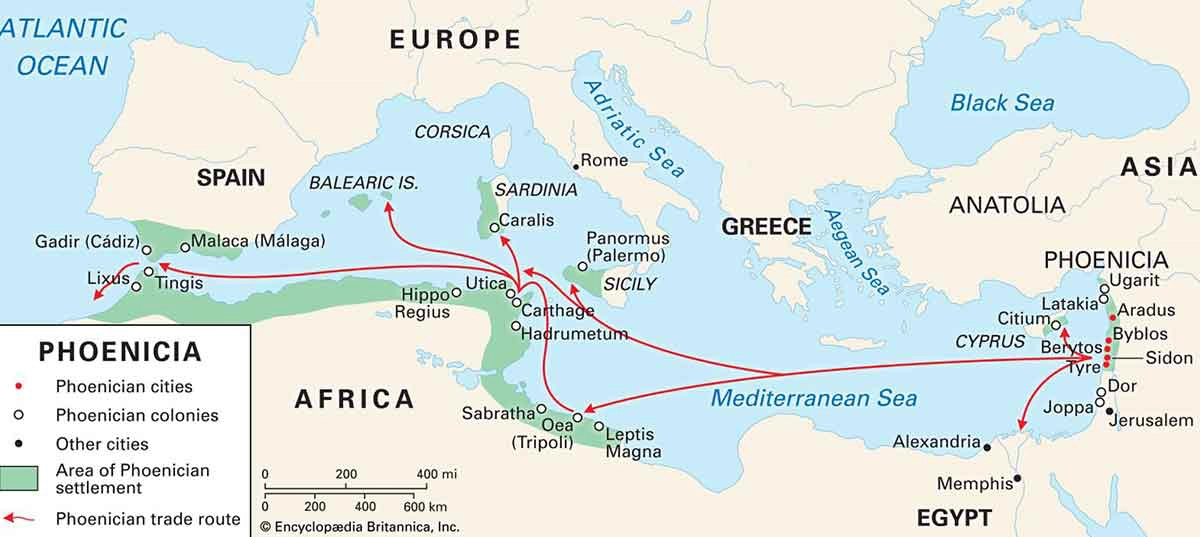
Regions: Levant, North Africa, Western Mediterranean
Drivers:
- Phoenician colonization (Tyre, Sidon, Carthage) spread trade routes for metals, dyes, and glass.
- Establishment of Carthage (9th c. BCE) as a commercial empire dominating western Mediterranean trade.
- Greek colonization (Magna Graecia, Ionia, Black Sea) brought agricultural and artisanal exchange.
- The use of coinage (Lydians, c. 7th century BCE) revolutionized commerce and taxation.
Outcome: Integration of east–west trade, growth of city-state mercantile elites, and maritime technological advances.
III. Classical and Hellenistic Economies (ca. 500 – 30 BCE)
Regions: Greek world, Egypt, Near East
Drivers:
- Athens’ silver mines and tribute system (5th c. BCE) created wealth and financed cultural expansion.
- Alexander the Great’s conquests (4th c. BCE) opened trans-Mediterranean and Asian markets.
- Ptolemaic Egypt became the grain powerhouse of the region.
- Hellenistic cities (Antioch, Alexandria, Rhodes) served as commercial hubs with multicultural trade diasporas (Greeks, Jews, Phoenicians).
Outcome: Urbanization, long-distance trade in grain, papyrus, olive oil, and wine; first large-scale monetized economies.
IV. Roman Mediterranean Integration (ca. 200 BCE – 400 CE)
Regions: Entire Mediterranean (“Mare Nostrum”)
Drivers:
- Roman unification of trade, law, and currency across Europe, Africa, and Asia Minor.
- Major infrastructure investment — roads, harbors, aqueducts, and administrative taxation systems.
- Expansion of agricultural estates (latifundia) and Mediterranean shipping lanes for grain (Egypt, Sicily), olive oil (Baetica), and wine (Gaul, Campania).
- Emergence of a vast consumer market supported by urban growth (Rome > 1 million people).
Outcome: The first integrated Mediterranean economy, characterized by Pax Romana trade flows and fiscal bureaucracy.
V. Islamic & Byzantine Economic Revival (7th – 12th centuries CE)
Regions: Eastern & Southern Mediterranean
Drivers:
- Arab conquest opened a unified trade zone from Spain to the Levant.
- Introduction of new crops (sugar, citrus, cotton, rice) — the “Islamic Green Revolution.”
- Revival of cities (Cairo, Tunis, Cordoba) and trans-Saharan trade routes.
- Byzantine commerce with the Silk Road and Eastern Mediterranean persisted, trading textiles, spices, and slaves.
Outcome: Agricultural diversification, rise of Muslim merchant networks, and re-energized maritime commerce.
VI. Medieval & Renaissance Expansion (13th – 16th centuries)
Regions: Italian city-states, Iberia, Levant
Drivers:
- Venice, Genoa, Pisa became maritime republics dominating spice and luxury trade with the East.
- Development of merchant banking and credit instruments (bills of exchange, double-entry bookkeeping).
- Crusader routes and trade concessions revived eastern commerce.
- Late in period: Iberian kingdoms launched Atlantic exploration, diverting trade but enriching Mediterranean ports.
Outcome: Commercial capitalism and finance originated in the northern Mediterranean; urban prosperity (Florence, Venice, Barcelona).
VII. Ottoman, Colonial, and Industrial Transformations (16th – 19th centuries)
Regions: Ottoman Empire, North Africa, Southern Europe
Drivers:
- Ottoman control unified eastern Mediterranean under state monopolies; Levantine Jews, Greeks, Armenians served as intermediaries.
- European mercantilism and colonial expansion gradually marginalized the Levant.
- 19th-century modernization: canal projects (Suez, 1869), steamships, cotton and tobacco exports, and port development (Alexandria, Marseille).
Outcome: Economic duality — industrial Europe vs. agrarian East and South; increasing Western capital dominance.
VIII. Twentieth to Twenty-First Century Integration (1900 – today)
Drivers:
- Post-WWI restructuring of colonial economies; oil discovery in North Africa and the Middle East.
- Post-WWII reconstruction and tourism transformed southern Europe (Italy, Spain, Greece).
- European Union expansion brought infrastructure and trade integration to Mediterranean members.
- Containerization, ports (Piraeus, Barcelona, Haifa), and energy transit routes (pipelines, LNG) define 21st-century growth.
- New blue economies: renewable energy, maritime transport, and digital logistics hubs.
Outcome: The Mediterranean remains a transcontinental economic corridor, balancing legacy industries, tourism, migration, and energy geopolitics.
🧭 Summary Table — Major Expansion Epochs
| Period | Approx. Dates | Core Drivers | Key Centers |
|---|---|---|---|
| Bronze Age | 2000–1200 BCE | Metal trade, palatial redistribution | Crete, Egypt, Ugarit |
| Iron Age | 1000–500 BCE | Phoenician & Greek colonization, coinage | Tyre, Carthage, Athens |
| Classical–Hellenistic | 500–30 BCE | Maritime trade, Hellenistic cities | Alexandria, Rhodes, Antioch |
| Roman Empire | 200 BCE–400 CE | Infrastructure, taxation, mass trade | Rome, Ostia, Carthage |
| Islamic–Byzantine | 7th–12th c. CE | Crop diffusion, trade revival | Cairo, Cordoba, Constantinople |
| Renaissance | 13th–16th c. CE | Banking, navigation, urban trade | Venice, Genoa, Florence |
| Industrial–Colonial | 16th–19th c. CE | Steam, cotton, canal, imperial finance | Marseille, Alexandria |
| Modern–Global | 20th–21st c. | EU trade, tourism, energy | Barcelona, Piraeus, Tel Aviv |
